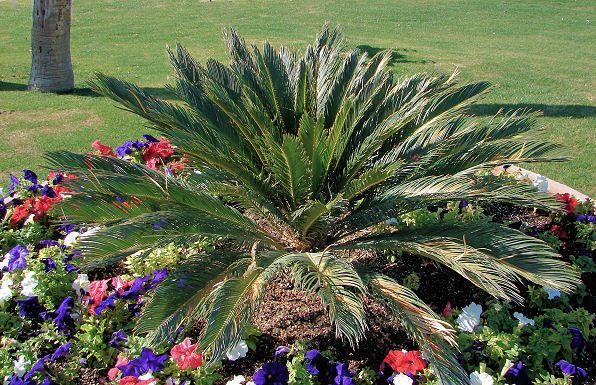
Not a true palm but a cycad, an ancient plant group more closely related to conifers. It forms a stiff, glossy crown of dark green fronds on a short, thick trunk and grows so slowly that a mature plant can be decades old.
Living with it in the Phoenix Valley
Watering
Follow the shrub, groundcover and succulent schedule in our Landscape Care guide. It stores water in its trunk and tolerates some dryness, but appreciates deep summer watering in the heat. Constantly wet soil causes yellowing and rot.
Pruning
Remove old fronds once they yellow or brown. Leave green fronds alone; with only one new flush a year, each one counts. Offsets at the base can be removed in spring.
Heat and sunburn
Afternoon sun and temperatures above about 115°F scorch the fronds. Morning sun with afternoon shade keeps it glossy. In dense shade it grows thin and leggy.
Feeding
Feed lightly. Overfeeding yellows the fronds, and very alkaline soil can cause speckling from magnesium shortage.
How our designers use it
Containers
Its slow growth and sculptural form make it a long-lived choice for large pots at entries and on covered patios.
Under a canopy
It fits the shade of a tree or the east side of the house, where many sun-loving accents struggle.
A formal accent
Paired at an entry or set in a raised planter, its symmetry suits more architectural designs.
Good to know
Pets
All parts are toxic to dogs, cats and horses, and the seeds are the most dangerous. Eating any part can cause severe illness, including liver failure. We generally avoid it in yards where dogs dig or chew. It is toxic to people as well.
Around the pool
Litter is minimal, but the stiff leaflets end in sharp tips. Keep it out of reach of walkways and play areas.