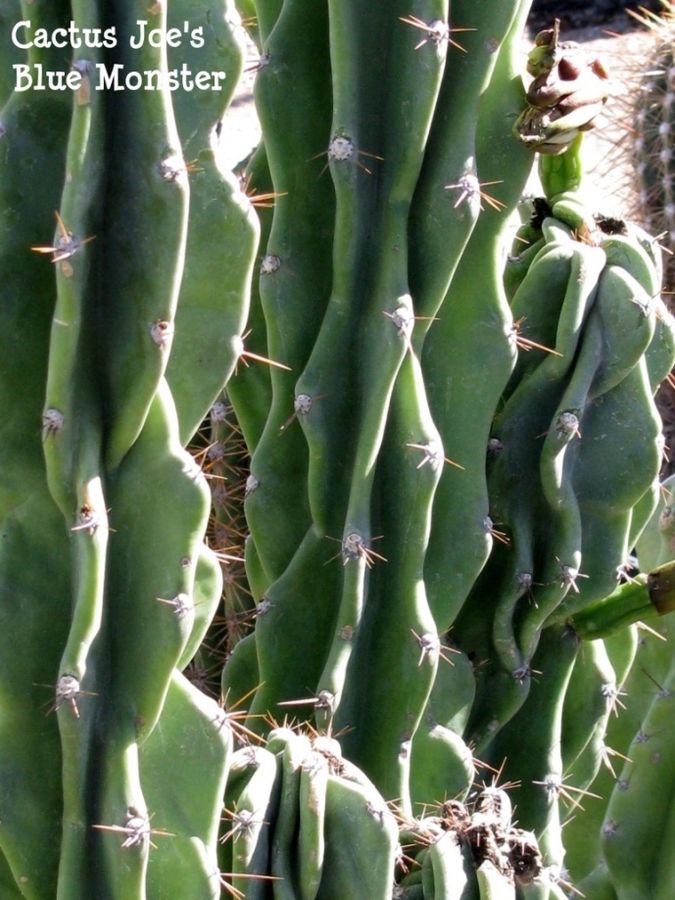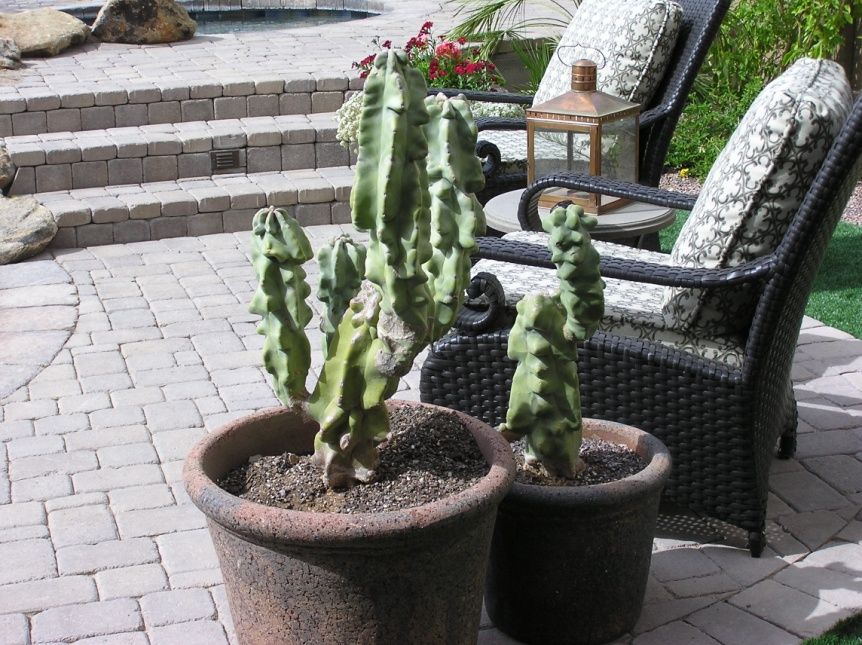
A natural mutant form of the senita cactus, with smooth, knobby, light green stems and no spines. No two plants look alike, and each one reads almost like a piece of sculpture. It is the most commonly seen unusual columnar cactus in Phoenix landscapes and one of the few that is comfortable close to where people walk.
Living with it in the Phoenix Valley
Watering
Follow the cactus guidance in our Landscape Care guide, which means hand-watering only when needed. Established groupings are very drought tolerant. Young plants and solitary specimens appreciate occasional deep water in summer. Gravelly, fast-draining soil prevents root rot.
Pruning
None needed. If a stem breaks or leans over, it can be cut, allowed to callus and replanted.
Cold
It is less frost tolerant than the straight senita. Cover stem tips with frost cloth when temperatures are forecast to drop into the mid-20s, since freeze damage leaves lasting scars.
How our designers use it
Sculptural accent
Its irregular, spineless columns give an architectural focal point in a courtyard, entry or modern landscape.
Softening a wall
Planted against a tall block or stucco wall, it adds vertical interest and breaks up a long, flat surface.
Raised beds and pots
It works well in raised planters and large containers, where its texture is at eye level.
Good to know
Around the pool
With no spines and almost no litter, it is one of the few columnar cacti we are comfortable placing near pools, paths and seating.
Growth rate
Its card describes it as fast growing, but it is slow. Buy it close to the size you want.